
Rocks

There is definitely a great deal of confusion between what constitutes a rock and not a mineral, but hopefully these conditions will help to clarify the differences.
Rocks:
…are derived from the latin word rocca meaning “rock” or “stone.”
…are generally composed of naturally occurring materials that may include minerals (can form crystals) or mineraloids (do not form crystals), crystals, bits of glass, embedded fossils, smaller rock pieces clumped together, or even compressed plant materials.
…can be classified as igneous, sedimentary or metamorphic.
…can be classified according to characteristics like their chemical composition, ratios of minerals, permeability, particle size and even various textures.
…can be man-made as well. Some man-made materials can be classified as rock-like if compacted into a hard substance, such as cementing materials. The scientific study of rocks and their constituents is known as petrology.
Minerals (and Mineraloids)
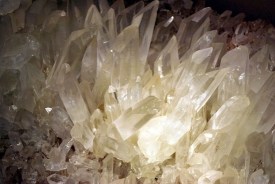
Minerals (can and usually do form crystals) and mineraloids (cannot form crystals), unlike rocks, are typically made up of one specific chemical composition rather than a conglomerate or aggregate as in the case of most rocks.
Minerals:
…are derived from the latin word mineralis which means “something mined.”
…are naturally occurring chemical compounds.
…have distinct physical properties that are related to their chemical composition and physical structure. They are classified by according to their crystal structure, habit, hardness, lustre, cleavage, magnetism, fracture, diaphaneity (transparency or translucency), color, streak, tenacity (behavior when broken or deformed), radioactivity, parting ability (splitting when broken along structural planes and parallel to a potential face), taste or smell, and their reaction to acid.
…are distinguished by various species depending on the geologic environment in which they were formed. Within a given species there may also be variations in physical properties or the presence of impurities that set them apart as a distinct variety within that species.
…fall into two dominant classification systems: The Dana Classification (primarily used in the US and divided into 8 basic classes – also the one used on this website) and the Nickel-Strunz Classification (primarily European and divided into 10 major chemical structural classes with subdivisions, families and groups) though there are other lesser used systems and no one system is “official”. (the Industrial Mineral Association or IMA tends to use neither and instead adopts a classification based on structure while others even base their classifications on location).
…are generally stable at room temperature (ie: solids) but include a few exceptions such as native mercury, and water ice.
…are represented by a chemical formula, usually an ordered atomic arrangement and usually abiotic, though if geological processes were involved in the genesis of the mineral than it is usually accepted.
Categories: General Information
 Skyfire Rocks and Minerals
Leave a comment